Invoice Letters
Overdue Invoice Letter Templates (For Day 35+ Invoices)
Jan 21, 2026
9 mins read
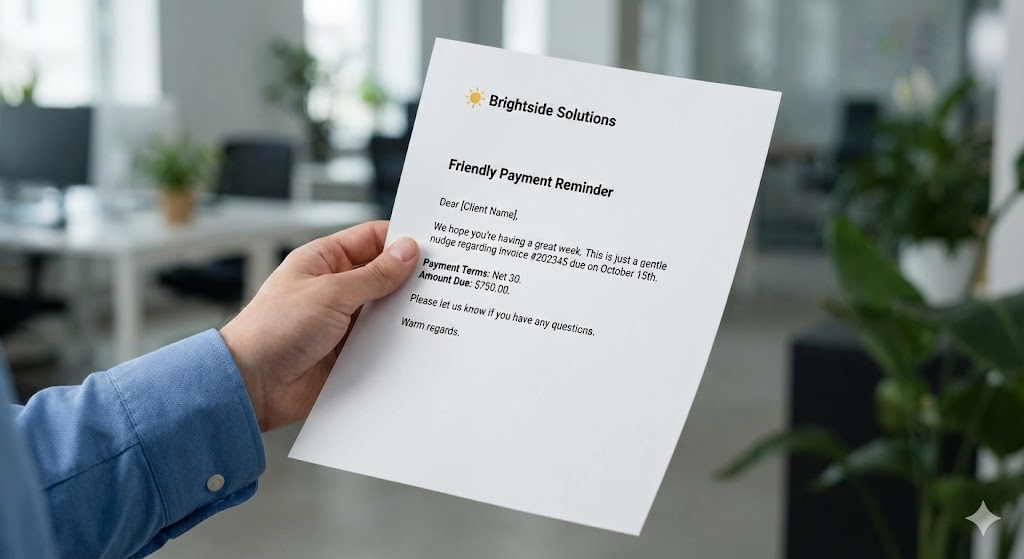
When an invoice hits day 35 overdue, email follow-up has stopped working.
You've sent multiple emails. Maybe you've called. Maybe they've made promises they didn't keep.
At this point, you need something more formal.
You need a letter.
Not another email.
An actual business letter that shows you're serious about collecting what you're owed.
Let me be clear about what we're talking about here: these aren't friendly reminders anymore.
These are formal demand letters. Letters that create a paper trail.
Letters that show you're one step away from legal action or debt collection.
If you've been using a systematic email follow-up process (like Invoice Nudge handles for days 1-28), you've already given them plenty of chances to pay.
Now it's time to escalate.
Why Letters Work When Emails Don't
Here's what happens psychologically when someone receives a formal business letter:
It's harder to ignore. Emails get buried. Letters sit on desks. They're physical. They demand attention.
It signals escalation. Most people know that formal letters mean you're serious. It's the step before lawyers and debt collectors.
It creates a legal paper trail. If you end up in court or using a debt collection service, having dated, documented letters strengthens your case enormously.
It feels more official. Even though it's just you typing it up, a letter on business letterhead feels more serious than an email.
It can't be claimed they "didn't see it." You can send letters via registered post with proof of delivery. They can't say it went to spam.
I'm not saying letters magically get you paid when emails didn't.
But they do get attention in a way that email #5 or #6 wouldn't.
And sometimes, that attention is enough to get movement.
When to Use Letters vs Email (The 35-Day Rule)
Here's the framework:
Days 1-28: Use personalised email
This is when friendly follow-up works. The invoice might have been forgotten. There might be a simple issue to resolve. Email is fast, non-confrontational, and effective.
If you're using Invoice Nudge, this entire period is automated.
The system creates drafts at days 7, 14, 21, and 28 that progressively get firmer. You review and send from your actual email.
Days 29-35: Pick up the phone
Email isn't working. Time for an actual conversation. Most issues can be resolved with a 5-minute phone call.
Day 35+: Send a formal letter
If phone calls haven't worked, or if you can't get them on the phone, it's time for a formal demand letter.
This is when you need the templates in this guide.
The 3 Types of Letters You Need
There are three distinct letters you'll use for day 35+ invoices:
Letter 1: The Formal Demand (Days 35-50)
This is your first formal letter. It's firm, professional, and makes it clear that you expect immediate payment. You're stating consequences without actually threatening legal action yet.
Letter 2: The Final Notice (Days 51-65)
This is your last attempt before escalation. You're explicitly stating that if payment isn't received by a specific date, you will engage debt collectors or pursue legal action. This isn't a bluff.
Letter 3: The Legal Demand (Day 66+)
This often comes from your lawyer (or at least on lawyer letterhead if you have access). It's the final step before actually filing in court. This letter usually mentions specific legal statutes and consequences.
Let me give you templates for each one.
Letter 1: The Formal Demand (Days 35-50 Overdue)
This is your first formal escalation. You've tried emails. You've tried phone calls. Now you're creating a paper trail.
Why this letter should work:
Formal demand in the subject line - Makes it clear this isn't another friendly reminder.
Specific invoice details - No ambiguity about what's owed.
7-day deadline - Specific and reasonable. Not "immediately" (too aggressive) but not "when you can" (too soft).
Clear consequences - You're telling them exactly what happens if they don't pay. No vague threats.
Opening for payment plans - Even at this stage, you're showing you're reasonable if they communicate.
Multiple payment options - Making it easy to pay removes excuses.
Without further notice - This is your final warning before action.
Letter 2: The Final Notice (Days 51-65 Overdue)
They didn't respond to Letter 1. Or they responded but didn't pay. Now you're done being patient.
Why this letter should work:
Final Notice and Legal Action Pending - No ambiguity. This is the end of the line.
References the previous letter - Shows you've been patient and they've ignored you.
Includes late fees - If your terms allowed for them, now's the time to add them.
Specific monetary consequences - "Your total liability could exceed $X" makes it real.
5-day deadline - Shorter than Letter 1. You're done waiting.
No more payment plan offers - You gave them that chance in Letter 1. Now it's full payment or escalation.
Sent via registered post - Proof of delivery. They can't claim they never got it.
CC to professional advisors - Shows you're already involving legal help.
Letter 3: The Legal Demand (Day 66+ Overdue)
At this stage, you're typically having a lawyer send this letter. But if you can't afford a lawyer yet, you can send this yourself as a final step before filing in small claims court.
Why this letter works:
Written as if from a lawyer - Even if you're sending it yourself, the formal legal language carries weight.
"Letter of Demand" - This is the recognised legal term. Courts want to see that you made a formal demand before filing.
Full timeline documented - Shows you've been more than reasonable.
Specific legal consequences - Credit file damage, public record, increased costs. Making it real.
7-day deadline - Standard legal timeframe. Courts see this as reasonable.
Opens door for dispute - Legally, you need to give them a chance to dispute. But most won't because they know they owe the money.
Time is of the essence - Legal language that shows you're serious.
How to Send These Letters for Maximum Impact
The format matters almost as much as the content.
Use business letterhead - Even if it's just your logo and contact details at the top. It looks more official than plain paper.
Print on quality paper - Not kidding. Heavy-weight paper (100gsm+) feels more serious than cheap copy paper.
Sign in blue ink - Shows it's an original, not a photocopy. Blue ink stands out.
Send via registered post - Costs a few extra dollars but gives you proof of delivery. Critical if you end up in court.
Keep copies of everything - Date sent, tracking number, proof of delivery. Document everything.
Send a PDF copy via email too - They might claim they didn't get the letter. Email removes that excuse.
Follow up the letter with a phone call - "Hi [Name], I wanted to make sure you received my letter dated [DATE] regarding invoice #[NUMBER]. I need payment by [DATE] or I'll be proceeding with the actions outlined in the letter."
Don't just send the letter and hope. Follow up.
What to Do If They Still Don't Pay
You've sent all three letters. They still haven't paid.
Now what?
Option 1: Engage a debt collection agency
They work on commission (typically 25-40% of what they collect). You pay nothing upfront.
If they collect $10,000, you get $6,000-7,500. Better than getting $0.
Option 2: File in small claims court
For debts under $10,000 (varies by state), you can file in small claims court without a lawyer.
Filing costs are usually $100-300 depending on the amount.
The process is designed for regular people to use.
If you win (and you probably will if you have documented proof), they're ordered to pay plus your court costs.
Option 3: Engage a lawyer
For larger debts ($10,000+) or complex situations, a lawyer might be worth it.
They'll usually want a retainer ($2,000-5,000 upfront).
But if the debt is substantial, it might be worth it to have legal representation.
Option 4: Write it off
Sometimes the healthiest thing you can do is write it off, learn from it, and move on.
If the debt is small, the client has no assets, or chasing it is destroying your mental health, let it go.
Claim it as a bad debt for tax purposes and focus on clients who actually pay.
Common Mistakes That Weaken Your Letters
I've seen business owners send letters that actually hurt their case instead of helping it.
Here's what NOT to do:
Don't make empty threats
If you say "I will file legal action by Friday" and then don't do it, you've lost all credibility. Only make threats you're prepared to follow through on.
Don't get emotional
"I'm so disappointed in you" or "I can't believe you'd do this to a small business" weakens your position. Keep emotion out of it. Stick to facts and consequences.
Don't apologise
"I'm sorry to bother you again but..." You're not bothering them. They owe you money. Don't apologise for asking for what you're owed.
Don't give vague deadlines
"Please pay as soon as possible" means nothing. "Payment due by 5pm Friday 15th March 2024" is specific and enforceable.
Don't send it from a personal email
Letters should come on business letterhead via post. If you email a copy, send it from your business email, not gmail.
Don't forget to include payment details
Make it easy for them to pay. Bank details, payment links, reference numbers. Remove all excuses.
Don't cc random people to try to embarrass them
Sending copies to their clients or business partners is unprofessional and could get you in legal trouble. Stick to relevant parties only (your lawyer, their accounts department).
The Psychology of Formal Letters (Why They Often Work)
Here's what happens when someone receives a formal demand letter:
Reality hits
Emails are easy to ignore. Letters are physical. They sit on desks. They're harder to forget about.
Fear of consequences becomes real
"This person might actually take legal action" shifts from abstract worry to concrete reality.
Third parties get involved
In businesses, letters often go to the accounts department or management, not just the person who's been ignoring your emails.
Their lawyer/accountant sees it
If they show the letter to professional advisors, those advisors will usually say "mate, just pay them."
It's harder to make excuses
You can ignore emails. You can avoid phone calls. But a registered letter with proof of delivery? Can't claim you didn't get it.
Letters don't work 100% of the time.
But they work more often than sending email #6 or email #7.
If you're past day 35 and emails aren't working, escalate to formal letters.
When to Send These Letters vs When to Just Call It
Not every invoice is worth the paper these letters are printed on.
Here's when to use them:
Use formal letters when:
The debt is over $1,000 (worth the effort)
You have clear documentation (invoice, contract, proof of delivery)
The client is responsive but not paying (letters might scare them into action)
You're prepared to follow through with legal action if needed
You want a paper trail for court or debt collection
Skip the letters when:
The debt is under $500 (costs might exceed what you recover)
The client has disappeared completely (they're not reading letters either)
They're clearly going bankrupt (you won't get paid anyway)
The relationship was messy from the start (cut your losses and move on)
Your mental health is suffering (sometimes writing it off is the healthiest choice)
Only you can decide if chasing a particular invoice is worth it.
But if you're going to chase it, do it properly with formal letters that create a paper trail.
The Alternative: Automate Days 1-28, Then Use Letters for Day 35+
Here's what smart business owners do:
They automate the first 28 days of invoice follow-up so they don't have to think about it.
Systems like Invoice Nudge handle days 7, 14, 21, and 28 automatically - creating progressively firmer email drafts that appear in your normal Gmail or Outlook.
You review them in 10 seconds and send from your own email address.
This catches 55-64% of overdue invoices before they hit day 35.
For the remaining invoices that don't respond to systematic email follow-up?
That's when you use these formal letter templates.
It's a two-tier system:
Days 1-28: Automated email follow-up (catches most overdue invoices)
Day 35+: Formal letters and escalation (for the stubborn ones)
This way, you're not wasting time on manual follow-up for invoices that will pay with a simple reminder.
You're saving your energy (and these formal letters) for the invoices that actually need escalation.
Learn more about Invoice Nudge or start your 14-day free trial.
Your Action Plan: What to Do Right Now
If you've got invoices over 35 days overdue right now:
Today:
Identify which invoices are 35+ days overdue
Pull together all documentation (original invoice, emails sent, phone call notes)
Choose the appropriate letter template based on days overdue
Customise the template with your specific details
Print on business letterhead and sign in blue ink
This Week:
Send Letter 1 (Formal Demand) via registered post
Email a PDF copy as well
Follow up with a phone call 2 days after they receive it
Document everything (date sent, tracking number, phone call notes)
Next 1-2 Weeks:
If no response or payment, send Letter 2 (Final Notice)
Start researching debt collection agencies or court filing process
Decide your cutoff point - what's the minimum amount worth pursuing?
Long Term:
Implement a systematic follow-up process for days 1-28 so invoices don't reach day 35
Tighten payment terms for new clients
Require deposits upfront
Screen clients more carefully before taking them on
The goal isn't to send these letters.
The goal is to get paid before you need these letters.
But when you do need them, use them properly.
The Bottom Line
If an invoice has hit day 35+ overdue, friendly email reminders aren't working.
You need formal business letters that:
Create a paper trail for legal action
Show you're serious about collecting
Make consequences crystal clear
Give them one final chance before escalation
The three-letter system works:
Letter 1 (Days 35-50): Formal demand with 7-day deadline
Letter 2 (Days 51-65): Final notice with specific legal consequences
Letter 3 (Day 66+): Legal demand, usually from a lawyer
Most invoices that respond to letters will respond to Letter 1.
If they don't respond to Letter 2, you're likely heading to debt collection or court.
But having these formal letters in your file shows you did everything reasonable to collect before escalating.
Courts and debt collectors want to see that you tried.
These letters prove you did.
Use them when email follow-up stops working.
And get paid what you're owed.
Related Resources
Want to handle earlier stages of invoice collection? Check out these guides:
Chasing Overdue Invoices Without Damaging Client Relationships
Xero & QuickBooks Invoice Reminders: Why They Don't Work (And What Does)
Unpaid Invoice Debt Collection: When and How to Use Debt Collectors
Want to automate days 1-28 so invoices don't reach day 35+? Invoice Nudge handles systematic email follow-up automatically, catching 55-64% of overdue invoices before they need formal letters. You only use letters for the stubborn ones. Start your 14-day free trial.